
Discover the secrets behind Eva Lendel’s iconic look. This guide explores the modern fabrics — from sleek crepe to structured mikado — that create minimalist and chic bridal silhouettes.
Fabric & Form: A Modern Bride’s Guide to Choosing Her Wedding Dress Material
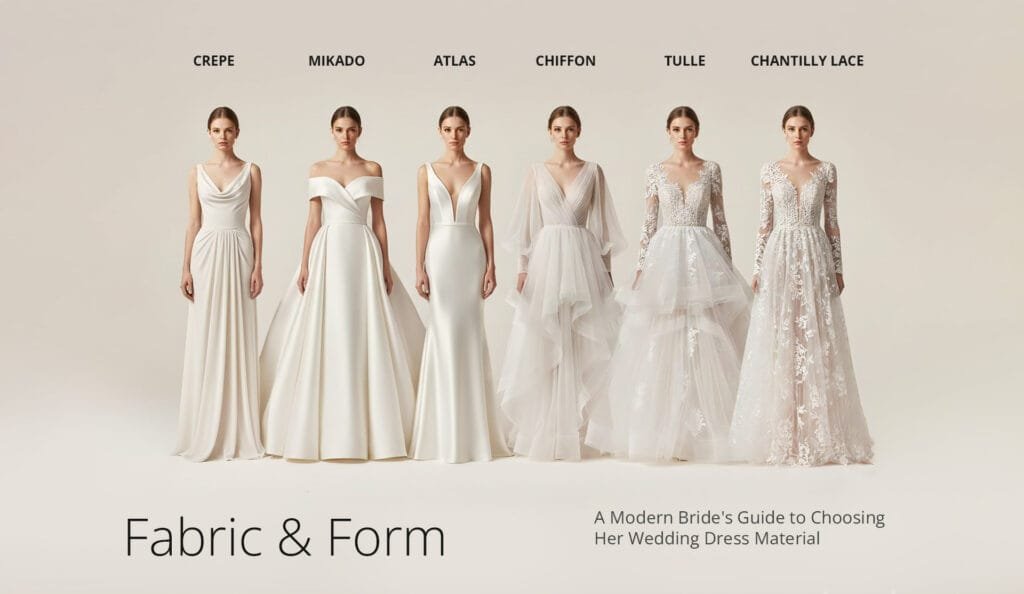
It is a false premise that the perfect wedding gown is decided entirely by decoration. Some brides focus so intently on the cut, the neckline, or the embroidery that they overlook the single most critical element: the textile. Just as a robust, tailored structured wedding dress requires architectural precision, it is an ultra-minimalist wedding dress fabric that defines the silhouette, the draping, and, ultimately, the feeling of natural confidence at your wedding.
At Eva Lendel, we create bridal with the dictum that Form Follows Fabric. The choice for a modern wedding dress material is not an afterthought, it is the very heart of the look. A stiff, weighty material will render the gown restrictive and outdated, but an amazing one makes the dress an extension of the very bride itself — flowing naturally, catching the eye, and sustaining a slender silhouette.
This is the ultimate bridal gown fabric guide, simplifying complex textile properties into easy, insider tips. We go beyond the traditional notions to focus on the materials that create the modern, streamlined silhouette of the design house. Becoming acquainted with these basics is the first step towards choosing the sleek bridal gown that feels as incredible as it looks. The label feels that luxury is not excessive ornamentation; it is impeccable fit and shapeline that is achieved by the correct material.
The Architect’s Tools: How Fabric Shapes the Modern Gown
In contemporary bridal design, the modern wedding dress material is the master of the final silhouette. The difference between a column gown that is body-hugging and dramatic, and an A-line that flows, is almost totally an issue of the weight, weave, and hand of the clothing material. This is the guiding principle for every design decision at the atelier.
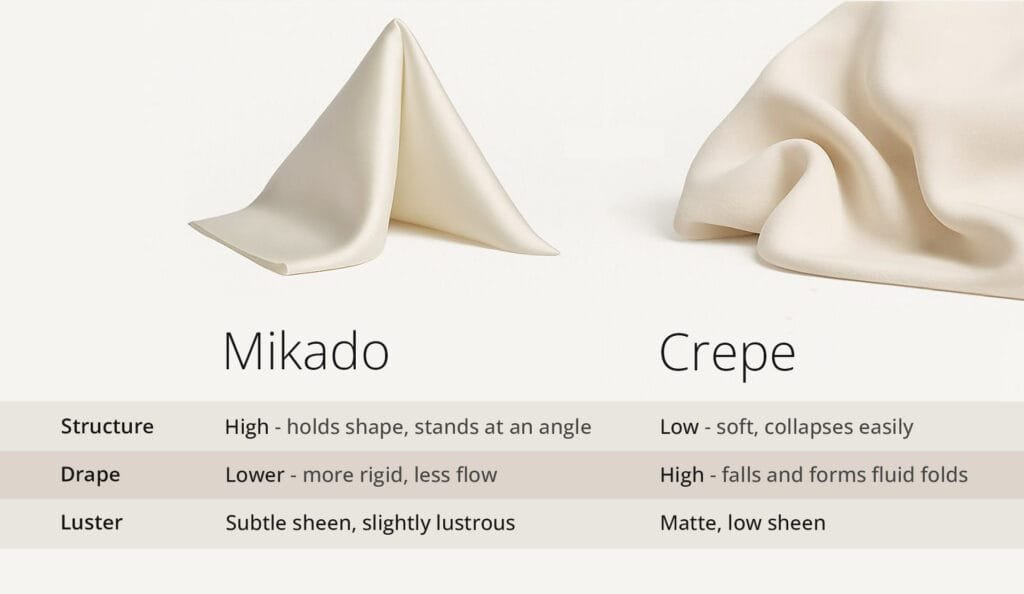
Fabric properties are always described subjectively, yet for that altar-seeking bride, who wishes to decide judiciously, she has to remember the following three objective properties:
- Drape (Fluidity): The draping and gathering of cloth. Thin-weight knits (e.g., chiffon) drape, great for slinky, bohemian or fabric for sheath dress styles.
- Structure (Rigidity): The ability for the material to form a shape away from the body. The structured wedding dress designs for bridal dresses rely on material (such as mikado) with inherent rigidity to form crisp lines, dramatic gathering, and architectural bridal gown skirts.
- Luster (Light Reflection): The fabric’s surface texture, from the crepe matte to the extremely high, mirror-like reflection occurring among some satins. The luster is extremely important, for it determines the weight and formality appearance of the bridal gown fabric.
A columnar line dress must contain sufficient weight to fall properly without sticking, and a ball gown with a defined outline requires a modern wedding dress material that contains sufficient weight to support the volume itself. That is the professional knowledge that brings your ultimate look to full bloom.
The Core Palette: Key Fabrics in the Brand Universe
Though textiles is a vast universe, the overall popularity of the collection has been centered on tradition and a sophisticated list of materials that have sophisticated texture as well as carry clean lines. They are employed only for the contemporary bride who requires minimalist wedding dress fabric that speaks volumes.
Crepe: The Epitome of Sleek Sophistication
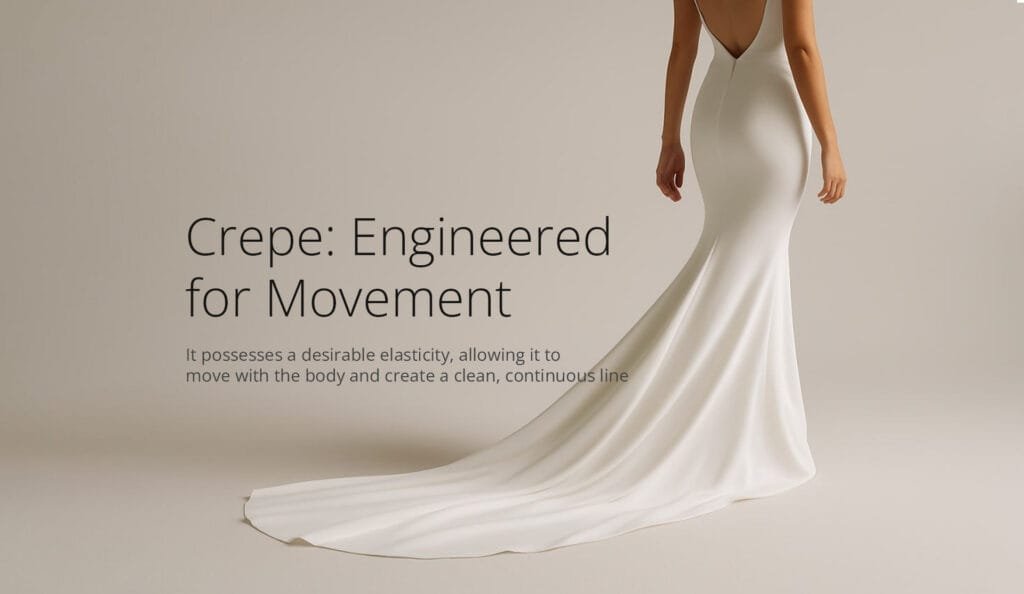
Crepe is the ultimate modern-day bride fabric, with elegance and simplicity. Although it is never given a second glance within the vintage bridal tomes, it is the backbone behind the brand aesthetic. Crepe is a fabric that possesses a slight, overall textured finish and very good drape.
- Look: It creates a matte, elegant finish that eliminates shine, keeping the focus very much on the outline of the bride. It is very stretchy and elegant, so it clings to the form rather than settling on it.
- The Feel: Although it is designed to produce a shaped silhouette, crepe is light and easy to wear. Its crisp, smooth feel makes it the perfect option for a tight-fitting bridal dress that has to be worn for an extended period.
- The Form: Crepe is perfect for mermaid, column, or straight dresses. The weight of the crepe gives an unbroken clean line from the shoulder to the hem, and it is the Minimalists’ ultimate wedding dress fabric.
View our whole collection of crepe wedding dress.
Mikado: For Sculptural and Minimalist Statements
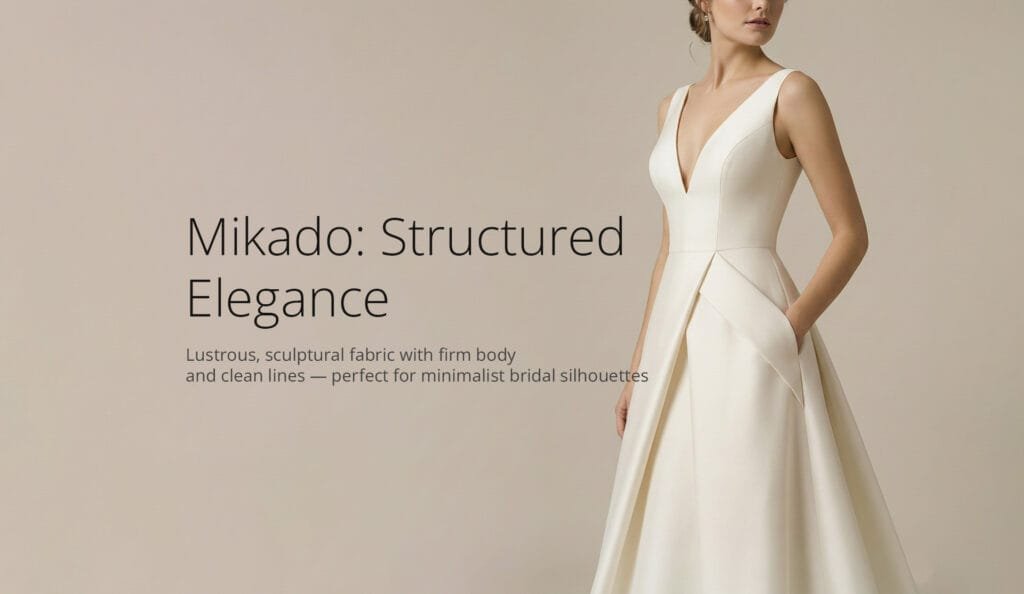
Mikado is the modern wedding dress material of the moment that demands attention without the use of glitter. Constructed from a blend of silks, the textile features a greater depth and a subtle, subdued sheen that sets it apart from traditional heavy satins.
- The Look: It’s excellent at holding shape, so it’s the “architect’s tool” of bridal design. Mikado is used to create dramatic, full skirts, crisp box pleats, or bold, off-the-shoulder necklines that stay perfectly vertical.
- Feel: Even though it is a heavyweight fabric, the tight weave creates a firm, luxurious look. It is also very supple to the touch and will not easily wrinkle, so the gown stays crisp and pretty all day.
- Shape: Ideal for ball gown and A-line shapes if Volume is wanted, or for the creation of dramatic, angular aspects that define an architectural wedding gown. Choosing a mikado wedding dress is a thoughtful, up-to-date decision.
Explore the mikado wedding dress collections with clean lines and silhouettes.
Satin: A Modern Take on Classic Luster
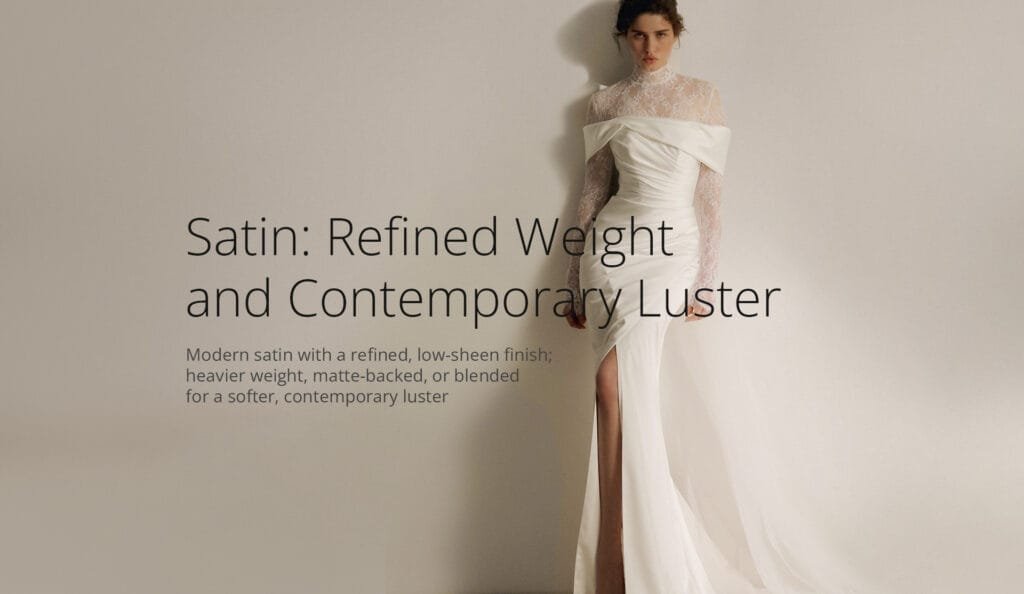
Satin is never going out of style, but for our universe, it’s reinterpreted for now. We employ versions of this textile — frequently heavier, matte-backed, or specially blended — with a less-shiny finish than the classical, too-fancy types.
- Appearance: It is characterized by a smooth surface and fine sheen. Satin creates a smooth, luxurious appearance for a dress, moving easily beside the contours of the body.
- The Feel: It is absolutely cool to the touch and smooth. The weight is ideal, with a beautiful, elegant drape that is never transparent.
- The Form: The satin bridal gown is also versatile, featuring both smooth slip dresses and more formal, modern ball gowns. It is a modern wedding dress material basic for the dressy, elegant finish-seeking brides.
Discover your stunning silhouette through our selection of satin bridal gown.
Beyond the Core: Understanding Lace and Tulle in Modern Design
While tradition places lace and tulle front and center, the design house recontextualizes these materials. Within the logic of contemporary design, they transition from being the central canvas to becoming elegant highlights — examples of textural sophistication that are placed above a lean, structured base.
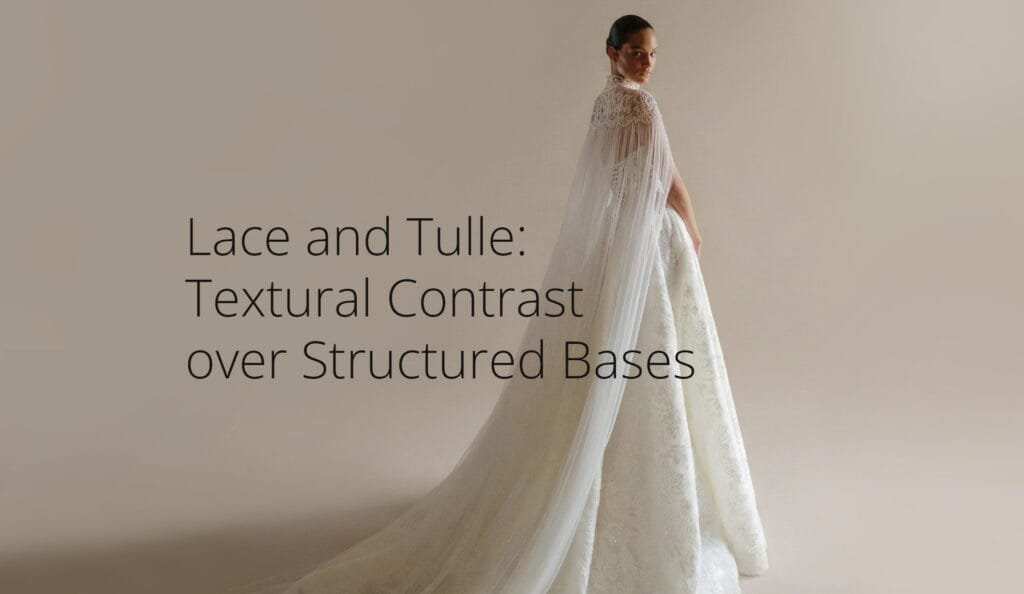
- Tulle: Its purpose is ethereal volume. Instead of full, multi-layered skirts, modern design uses tulle selectively: as a diaphanous, delicate sleeve, a soft layer of veil, or a small, dramatic pouf detail on a bodice. Its lightness (a lightweight fabric) is preserved to create an airy contrast with the dense core materials.
- Lace (e.g., Chantilly): Contemporary usage treats lace as a form of art. Selective use — an intelligent panel, a demure cuff, or an removable overlay — is more prevalent than all-over coverage. Such reserve is certain to prevent the Intricate floral designs found in Chantilly lace from challenging the clean lines that are the hallmark of Eva Lendel design.
Function Meets Fashion: Choosing Fabrics for Season and Comfort
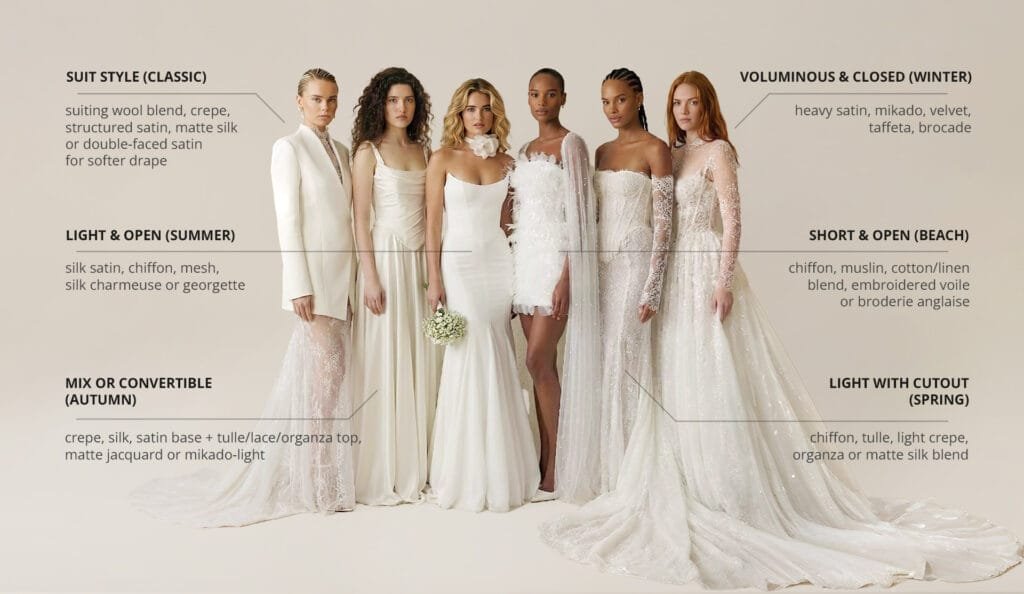
A working knowledge of material weight is the only way to prevent distress. Like with all educated decisions within your wedding process, it is your task to take action with coordinating your bridal gown fabric with the atmosphere of your event. The premise that a gorgeous gown has to be uncomfortable is an antiquated fallacy.
- For Spring/Summer or Tropical Weddings: Look for lightweight material with very good breathability. Crepe and chiffon material, due to their light, flowing texture, are perfect. If you want a structured wedding dress, look for designs where the bodice is the only area that is crafted with heavyweight material (e.g., Mikado), with the gown at the bottom being tiered with breathable material.
- For Winter/Cool-Weather Weddings: Here heavyweight fabric takes over. Mikado, heavy satin, or even crepe lined with an inner heavy lining, provide the support and warmth without the added bulk.
- Blends: Many higher-end bridal gown fabric designs are achieved through blends — the sheen of satin blended with the strength of synthetics — to provide the ultimate in both form and airiness: stylish form and functional airiness. The designer will use this method to achieve the perfect movement and wearability.
The Eva Lendel Fit: The Importance of Structure and Lining
True luxury for a wedding gown is the inner construction. The focus is not solely on the outside material, but the method that the dress is made to construct the shape around the body and to realize ultimate comfort.
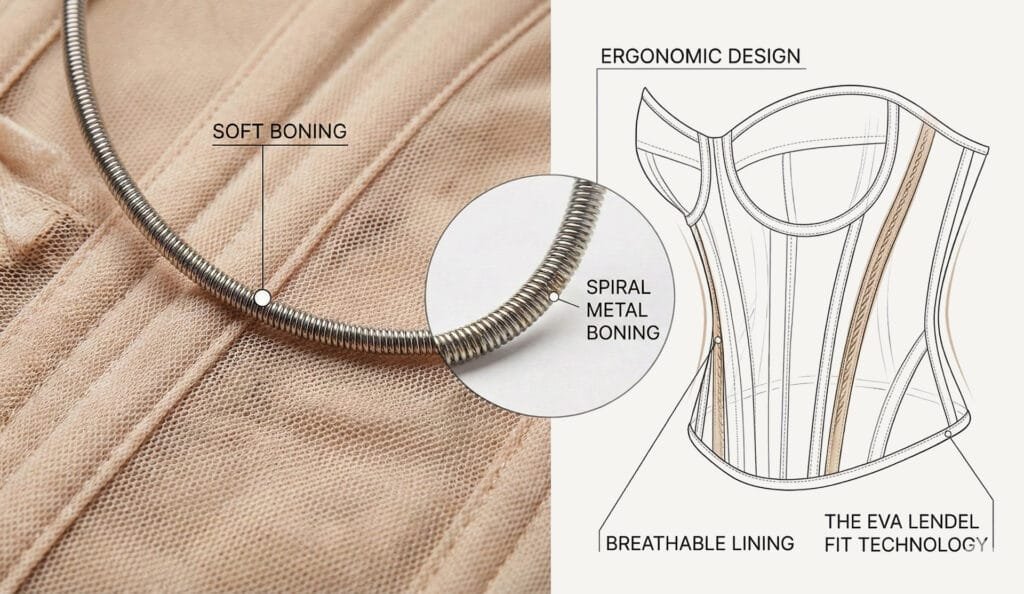
Present wedding dress construction departs from the stretched, strained corset gown. The Eva Lendel Fit however, depends more on:
- Flexible Support and Soft Boning: The inner support employs flexible, top-quality boning and gentle lining to shape the bodice without squeezing or restrictive movement. Bodice shaping, not squeezing, is the objective.
- The Sub-Fabric: The lining and interlining — often an afterthought — come first. First-rate, breathable linings mean that regardless of heavyweight material, for example, the Mikado, the textile next to your skin is smooth, gentle, and breathable, keeping irritation away and offering an ease that comes naturally to you come your celebration.
Professional alterations are the final, non-negotiable step. It is what turns a lovely dress into a comfortable, personalized second skin, so that the internal seams and darts fall absolutely flat.
Your Questions on Modern Fabrics, Answered (FAQ)
Will a crepe dress show flaws?
This is a significant issue with crepe wedding dress designs. Because crepe drapes close to the body and has a matte finish, it’s less forgiving than a full tulle or a highly embroidered textile. But rather than “showing imperfections,” a well-made crepe will simply skim the lines of the body. The solution lies entirely in the internal structure. The collection runs the gamut of precise contouring and luxe, smoothing linings that allow the crepe to drape fluidly, delivering a supportive, second-skin fit that flatters, not flaunts.
Will the Mikado be too warm for a summer wedding?
Not necessarily, but it will need to be styled with care. The Mikado is a heavyweight material and will carry more heat than a chiffon. For a summer wedding, we suggest an architecturally simple Mikado pattern — fewer layers to the skirt, shorter sleeves, or an easy A-line shape. Weight is medium, if the ceremony is not scheduled for the heart of peak mid-day heat and the lining is extremely breathable. It’s always a compromise: form or complete airiness.
How do I prevent a satin dress from wrinkling?
Wrinkling is the natural problem of any beautiful satin bridal gown. Although contemporary satin blends are stronger than 100% silk, prevention is ideal. The perfect solution is to have the dress shipped with care and hung up the moment it arrives. On the day, very lightly use a fabric steamer (never direct iron) inside the textile. Keep in mind, tiny, natural creases that develop with movement are indicative of a flowing, quality textile and are a part of the day’s character.
Take Control of Your Bridal Narrative
Selecting your modern wedding dress material is the most natural decision within your process. It is where your sense of style meets practicality. Do away with the blanket advice and start making informed decisions with the help of fabric attributes.
Comfort is the new luxury. Pay attention to what matters, know your ideal space, and find an upholstery that sets you free.
Ready to experience the architectural accuracy and simple luxury that is the Eva Lendel style?
Expert Citations and Technical Principles
These technical insights and maxims are derived from established textile science and current bridal manufacturing techniques. They are included to confirm the importance of the material selection to replicate the Eva Lendel appearance.
[1] The Principle of Architectural Stiffness (Mikado): The Textile Institute (UK) defines “Body” as the stiffness and resilience of a fabric—the key property of Mikado. Unlike draping materials, Mikado’s structure, often achieved through heavy gūgā-ji (gum-treated silk) or synthetic blends, allows the fabric to stand away from the body, making it the primary choice for voluminous, architectural wedding gowns (as seen in Mikado: For Sculptural and Minimalist Statements).
[2] Crepe and the Modern Minimalist Drapes: Design philosophy indicates that this transition to crepe material expresses a larger paradigm towards ‘honest minimalism’. As stated in various fashion publications, a crepe wedding gown must have its entire aesthetic success ride on its fluid Drapes, as there ‘is literally nowhere to hide.’
This expresses perfectly the confidence that a minimalist, nude-crepe bridal gown exudes as it literally has ‘nowhere to hide.’
[3] Internal Support Development (Wearable Ergonomics): Studies in Wearable Garment Ergonomics illuminate that there has been a move away from heavy steel busks, typical of older corsetry. With a modern design involving spiral steel or polymer resins, it has been ascertained that pressure areas may decrease by as much as 40% over more traditional corsetry designs. It is this notion of supportive design which establishes our promise of wearing comfortably, as outlined in our FAQ.
[4] Luster Control with Proper Reflectivity: Professional Photographers Association technical guidelines or high-end bridal gown fabric suppliers may refer to a controlled reflection of light. A high Reflectivity Index, indicative of pure or glossy satins, may create a ‘whiteout’ effect in photographing a bride. This led designers to prefer a toned or matte-backed/satin fabric that produces a controlled, sophisticated sheen, now synonymous with a fashionable wedding gown fabric for its sophisticated light reflections.
You Might Also Be Interested In:
- How to Style a Minimalist Wedding Dress: Uncertain how to accessorize a skin-fitting bridal gown (sleek bridal gown)? Check out this guide to newest veils, jewelry, and shoes to finish your sleek look.
- The Eva Lendel Silhouette Guide: Discover the Sheath, A-Line, and Column dress variation and discover what is ideal for your figure.
Care for Your Gown: Wedding Aftercare Preservation Advice